Crossover music has emerged as a powerful phenomenon in the music industry, capable of transcending borders and connecting people across diverse cultures. This genre, which blends elements from different musical styles, plays a vital role in global cultural exchange. Through the fusion of rhythms and melodies, crossover music has the power to unite audiences that might otherwise never have found common ground.
The impact of crossover music on cultural exchange is reflected not only in expanding audiences, but also in the evolution of musical genres themselves. Artists around the world are collaborating and experimenting with fresh combinations of styles, resulting in a rich musical diversity that enriches everyone involved. This movement benefits not only the artists, but also gives listeners a richer, more varied musical experience.
Throughout this article, we will explore how crossover music has shaped global cultural exchange, highlighting standout collaborations and analyzing how these musical encounters have fostered deeper understanding and appreciation across cultures. We will also examine how JDimate uses his art to connect people around the world through his music.
Join us on this musical journey and discover the power of music to unite hearts and minds!
What Is Crossover Music?
In music, a crossover refers to the moment when an artist, song, or style transcends its original genre and connects with a wider audience—often crossing cultural, linguistic, or commercial boundaries. This happens, for example, when a Latin track climbs the global pop charts, or when genres like reggaeton and R&B or flamenco and electronic music are fused together. Crossover is a powerful creative and strategic bridge to expand audiences, internationalize careers, and generate impact far beyond expectations.
👉👉Listen to an example of Crossover Music here
Iconic Musical Collaborations
Collaborations between artists from different genres and cultures have proven to be a powerful catalyst for cultural connection. A landmark example is the collaboration between Luis Fonsi and Daddy Yankee on “Despacito,” which became a global phenomenon. Bringing Justin Bieber onto the remix expanded its reach even further, introducing Latin music to English-speaking audiences and proving the power of crossover music to transcend linguistic and cultural barriers.
Another standout example is the collaboration between Shakira and Beyoncé on “Beautiful Liar,” a track that blends pop, Latin rhythms, and R&B. This partnership not only united two superstars from different cultural backgrounds, but also brought their respective fan bases together into a shared musical experience that resonated worldwide.
Crossover Impact on the Global Audience
Data backs up the massive impact of crossover music on global listeners. According to Spotify research, crossover collaborations drive a dramatic surge in streams for the participating artists. For instance, six months after the release of “Despacito (Remix),” Luis Fonsi’s Spotify streams jumped by more than 2,600% compared to the previous six months.
Similarly, the collaboration between Rema and Selena Gomez on “Calm Down” sparked a 230% increase in Rema’s daily streams in North America and a 120% increase in Selena Gomez’s daily streams across Sub-Saharan Africa. These numbers show how crossover music not only introduces artists to new audiences, but also drives meaningful cultural exchange.
Insights from Crossover Industry Experts
Case studies and industry insights further reinforce the role of crossover music in bridging cultures. According to John Stein, Head of Editorial for Spotify North America, “musical collaborations can bridge genres and open new avenues for creative exploration, while uniting each artist’s fan base and creating an opportunity to expand their audiences.”
A classic case study is the groundbreaking collaboration between Run-D.M.C. and Aerosmith on “Walk This Way,” which not only revitalized Aerosmith’s career, but also helped pioneer the rap-rock subgenre. Decades after its release, the track has racked up hundreds of millions of streams on Spotify, proving the lasting legacy of crossover music.
You may also like: Mastering the Art of Musical Genre Fusion
The Evolution of Crossover Music Over Time
Crossover music has undergone a remarkable transformation since its beginnings, adapting to cultural and technological shifts across the decades. This evolution has kept the movement relevant and established it as a driving force in global cultural exchange.
To better understand this evolution, it helps to look at a timeline highlighting the key milestones in the history of crossover music.
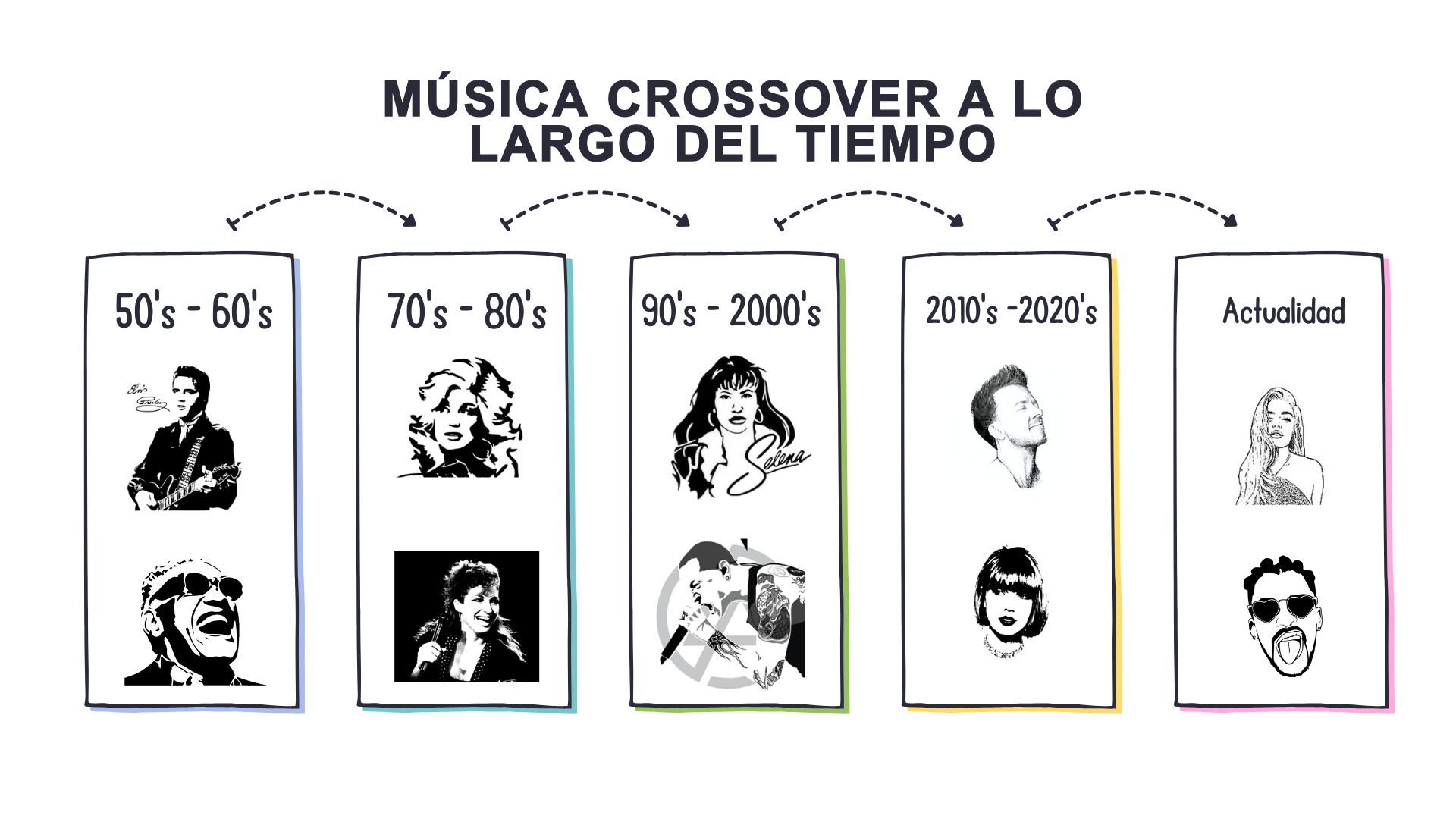
The Early Years: 1950s – 1970s
Crossover music began gaining traction in the 1950s and 1960s, when pioneers like Ray Charles and Elvis Presley started blending gospel, blues, country, and rock and roll. This fusion of styles drew listeners from diverse backgrounds, laying the foundation for the future of crossover music.
In the 1970s, disco and funk also played a major role in the evolution of crossover. Bands like Earth, Wind & Fire and artists like Donna Summer combined soul, pop, rock, and electronic synthesizers to create a sound that resonated across the globe.
The Golden Era: 1980s – 1990s
During the 1980s and 1990s, crossover music reached new heights. Icons like Michael Jackson and Madonna dominated the charts through their ability to blend pop, rock, R&B, and dance. Those decades also gave rise to historic collaborations—such as Run-D.M.C. and Aerosmith on “Walk This Way”—that brought rap-rock into the mainstream.
At the same time, globalization and new media technologies allowed crossover music to travel faster than ever, reaching audiences worldwide through MTV and emerging broadcast platforms.
The New Millennium: 2000s – Present
In the 21st century, crossover music has continued to evolve and expand. The digital streaming era has unlocked borderless distribution and collaboration between artists from different countries and genres—exemplified by Luis Fonsi, Daddy Yankee, and Justin Bieber on “Despacito (Remix),” which became a historic worldwide hit.
Electronic music has also played a pivotal role in modern crossover evolution, with DJs and producers like David Guetta and Calvin Harris fusing pop, dance, Latin, and hip-hop elements to craft international chart-toppers.
Impact of Karol G’s Album Tropicoqueta on Crossover Music
With Tropicoqueta, Karol G goes far beyond reggaeton: she explores merengue, bachata, cumbia, vallenato, mambo, and even mariachi, crafting a sonic mosaic that pays tribute to Latin roots while pushing crossover music toward new frontiers. Inspired by 1990s telenovela aesthetics, this bold and colorful musical journey not only blends genres, but rebuilds a vibrant cultural narrative connecting generations and styles.
Right away, Tropicoqueta positioned itself as a high-impact summer album: lead singles like “Si Antes Te Hubiera Conocido” and “Latina Foreva” topped charts and built anticipation for an international tour. With this project, Karol G not only celebrates her roots, but cements her role as an architect of global Latin music trends.
The Future of Crossover Music and Its Potential for Cultural Exchange
Crossover music has proven to be a powerful force in global cultural exchange—but what does the future hold? As the world becomes increasingly interconnected, the opportunities and challenges for genre-blending artists continue to evolve. In this section, we explore expert predictions and future trends shaping the road ahead for crossover music.
JDimate as a Benchmark in Modern Crossover Music
JDimate is one of the standout voices in today’s Latin and bilingual crossover music movement. His artistic vision combines the richness of Latin rhythms—such as salsa, merengue, vallenato, bachata, and reggaeton—with global pop, acoustic rock, electronic music, and English-language songwriting, creating a sonic fusion that transcends borders.
Every release in his Caleidoscopio series is a multicultural experience crafted not only for Latin audiences, but also for international playlists and global listeners. Through his borderless vision, bilingual catalog, and genre-blending production, JDimate represents a new generation of Latin crossover artists: living proof that crossover is not a passing trend, but a bridge between cultures, languages, and emotions.
>>Listen to Modern Crossover Music Here<<
Opportunities and Challenges for the Genre
The future of crossover music is full of opportunity, yet it also presents key challenges. One of the greatest opportunities is the ability for artists to collaborate internationally, sparking entirely new subgenres and hybrid styles. At the same time, globalization requires navigating diverse markets while staying true to local cultural roots.
Economic sustainability is another ongoing challenge for independent and crossover artists. While streaming platforms provide global reach, building a sustainable career requires balancing authentic musical experimentation with long-term audience connection.
Recommended Articles on Crossover Culture & Musical Fusion:
You may also like: To dive deeper into how these rhythms crossed borders, read our guide on the evolution of Latin music in the crossover movement.
If you love genre-blending fusion, stream the official JDimate Crossover playlist on Spotify.
Listen to Official Playlist